


If you have ever stepped into a gym sauna and felt an immediate blast of scorching heat near the ceiling while your feet stayed surprisingly cool, you have experienced one of the most common frustrations in commercial sauna design. Temperature inconsistency is not just uncomfortable—it limits how long people can safely stay inside, reduces the health benefits of the session, and drives members away from an amenity that should be a major selling point. A sauna air blending system solves this problem at the source, and understanding how it works can help gym operators and contractors make smarter decisions when specifying or upgrading sauna equipment.
This guide answers the most common questions about sauna air blending technology in public gym settings, from the basic science behind how it works to what you should look for when selecting a system for a commercial installation. Whether you are a gym owner, a sauna contractor, or a facilities manager, you will find practical, technically grounded answers here.
What is a sauna air blending system, and how does it work?
A sauna air blending system is a climate device that actively circulates air within the sauna room to eliminate temperature stratification. Instead of letting hot steam collect near the ceiling while cooler air sits near the floor, the system draws superheated air from the upper zone of the room, mixes it with cooler air near the floor, and redistributes it evenly throughout the space as consistent, breathable steam.
In a traditional sauna without air blending, convection does most of the work: hot air rises, cool air sinks, and the two layers rarely mix effectively. An air blending system replaces this passive process with an active one. A fan inside the climate device pulls the scalding air that accumulates beneath the ceiling, blends it with oxygen-rich air from the lower portion of the room, and guides the resulting soft steam back into the sauna at a comfortable, consistent temperature.
Our patented technology takes this a step further. The system captures the intense steam vapor that rises to the ceiling after water is thrown on the stones, mixes it with cooler, floor-level air, and returns it as a gentle, even leil—the Estonian word for the soft steam that defines a great sauna session. The result is a room where the temperature from floor to ceiling is far more uniform, breathing feels easier, and guests can stay longer and enjoy the session more fully.
Why does temperature stratification happen in gym saunas?
Temperature stratification in gym saunas happens because hot air is less dense than cool air and naturally rises to the ceiling, while cooler, heavier air settles near the floor. In a sealed sauna room without active air circulation, this creates distinct thermal layers—the ceiling zone can reach extreme heat while the lower zone, where people sit or stand, remains significantly cooler.
In a public gym setting, this problem is often more pronounced than in a private home sauna. Commercial saunas typically have larger volumes, higher ceilings, and heavier foot traffic, all of which make passive heat distribution less effective. Glass doors and uninsulated wall sections—common in gym saunas for safety and aesthetics—further compound the issue by creating cold spots that pull heat unevenly through the room.
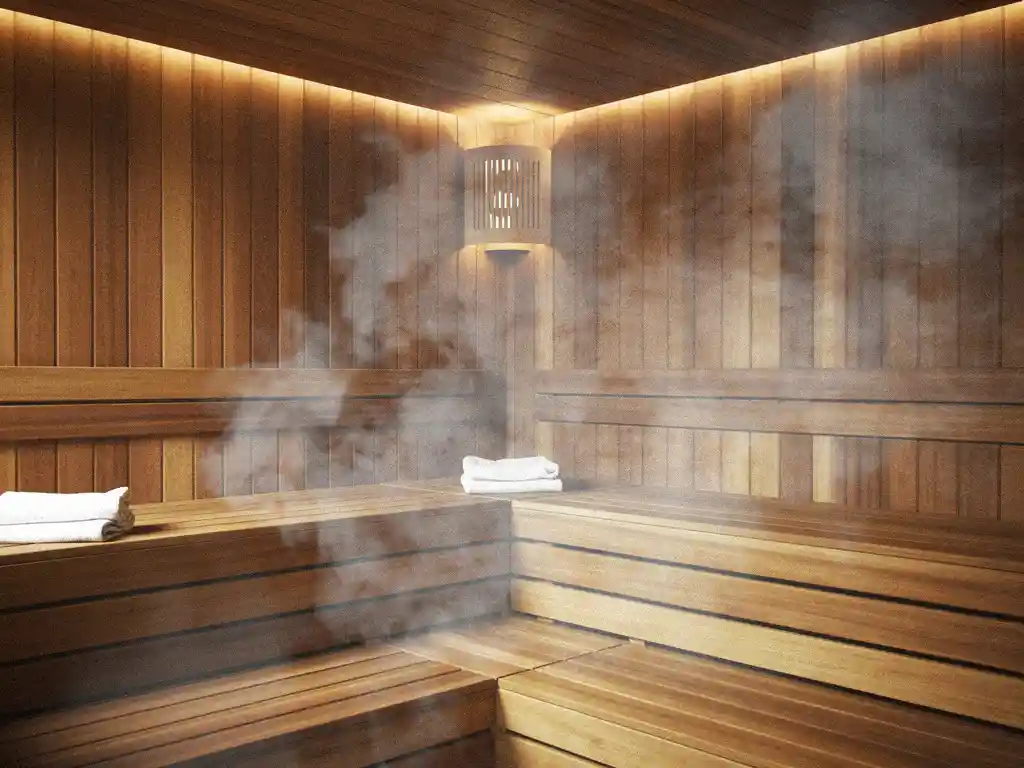
When water is thrown on the heater stones, a burst of steam rises immediately to the ceiling, where it concentrates and lingers. Without a mechanism to bring that steam back down, the person sitting on the lower bench barely feels the effect of the Aufguss ritual. This is the core problem that sauna ventilation and air blending technology are specifically designed to address. The temperature difference between the ceiling and the floor in a conventional sauna can be dramatic enough to make the lower benches feel almost tepid while the upper zone is uncomfortably intense.
How does a sauna air blending system improve the gym sauna experience?
A sauna air blending system improves the gym sauna experience by creating uniform temperature and steam distribution from floor to ceiling, making the entire room usable and comfortable rather than just the upper bench. Members can breathe more easily, stay longer, and enjoy a genuinely restorative session instead of enduring an uneven, often harsh environment.
The benefits extend beyond simple comfort. When the air is evenly blended, the oxygen concentration throughout the room is also more consistent. Dense, ceiling-concentrated steam in a conventional sauna can feel suffocating, particularly for gym members who are already breathing harder after a workout. An active air blending system mixes oxygen-rich air into the circulating steam, which noticeably reduces the sensation of breathlessness that drives many people out of a sauna prematurely.
For gym operators, the practical upside is significant. A sauna that members actually enjoy using becomes a retention tool rather than an underused amenity. Steam can be thrown more frequently because the blended air recovers more quickly and evenly, making each Aufguss round more effective. Humidity levels in the room also stay higher and more consistent, which supports better perspiration and the detoxification benefits members expect from a sauna session.
What are the key components of a sauna air blending system for commercial use?
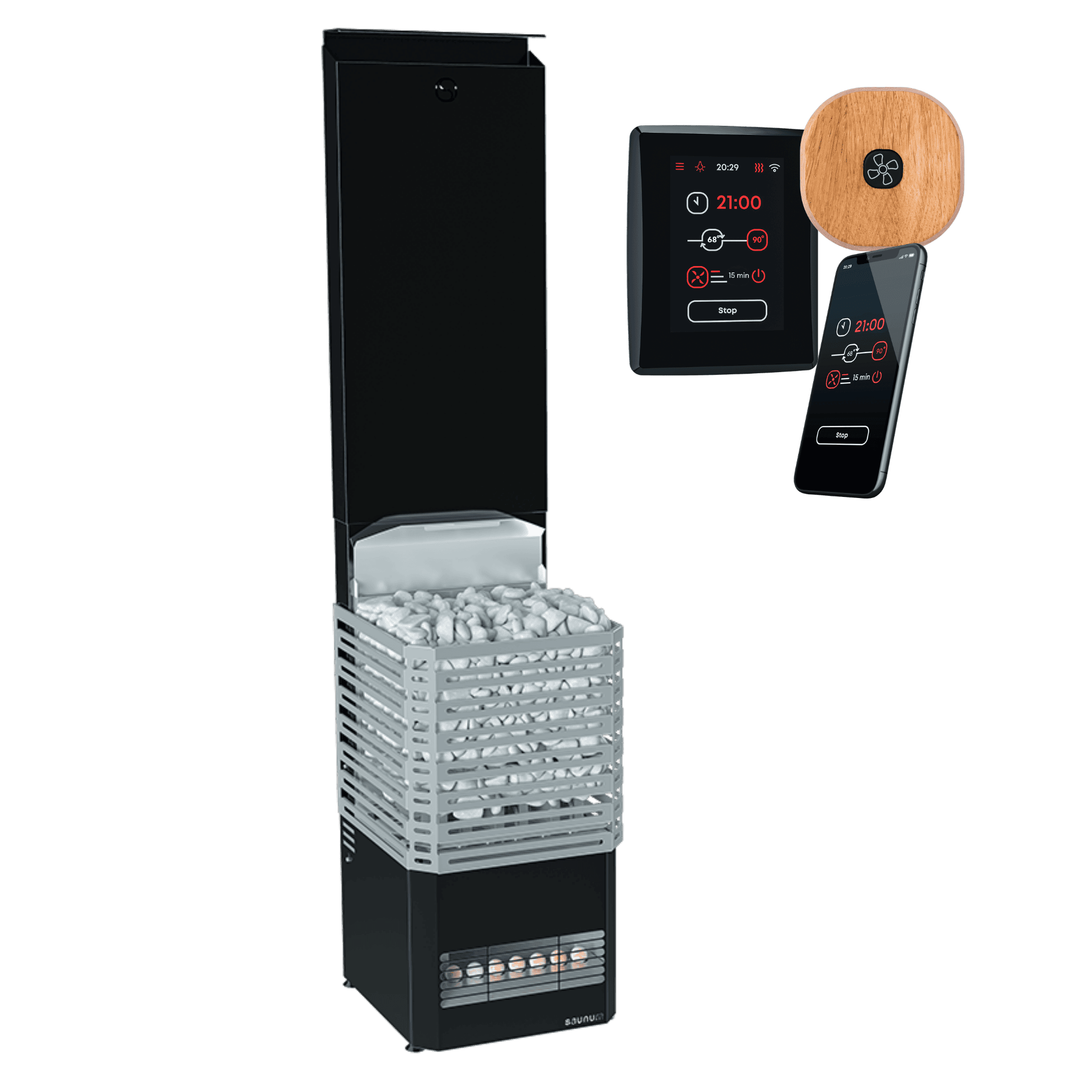
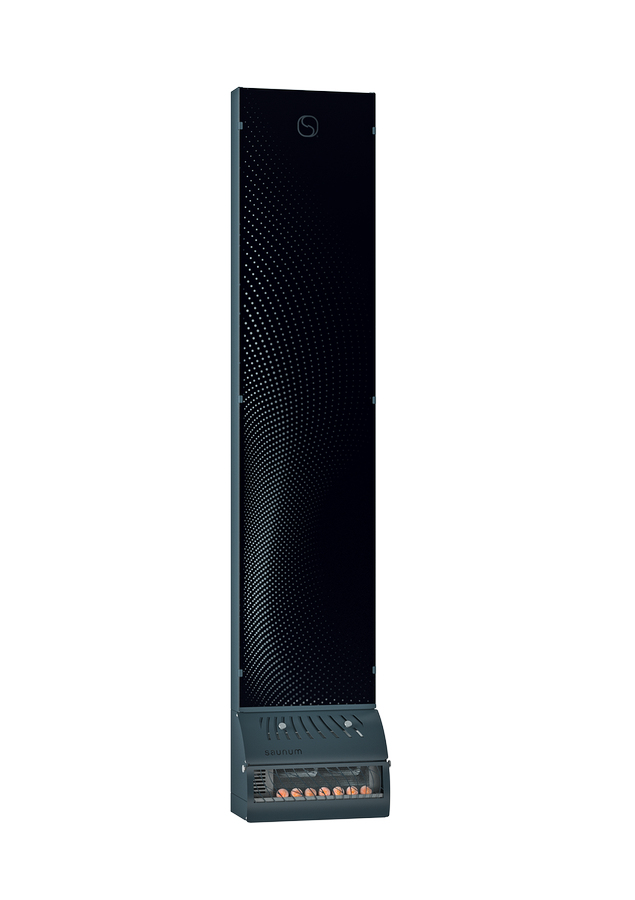
A commercial sauna air blending system consists of three core elements: the climate device itself (which houses the fan and air-circulation mechanism), the heater that generates the steam, and a control unit that manages temperature, fan speed, and timing. In modern integrated designs, the climate device is built directly into the heater body, eliminating the need for a separate visible unit on the wall.
The climate device and fan assembly
The climate device is the heart of the air blending system. It contains a fan that operates at multiple speed levels, allowing the operator to adjust the intensity of air circulation depending on the sauna mode being used. A vent valve controls how much air is drawn in and redistributed, providing fine-grained control over humidity and steam distribution. In commercial-grade units designed for boutique public saunas, the fan assembly is built to handle the extended operating hours and higher throughput that a gym environment demands.
The heater and stone basket
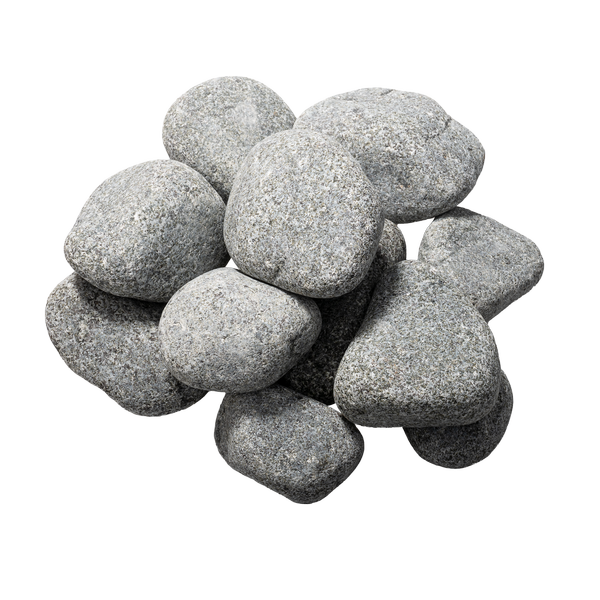
The heater generates the heat and steam that the climate device then circulates. For a gym setting, power sizing is critical—the heater must be matched to the actual volume of the sauna room, accounting for any uninsulated surfaces such as glass doors or concrete walls. A dual-level stone basket design distributes water evenly across the top stone layer, which reduces thermal shock to the heating elements and extends their lifespan—an important consideration in a high-use commercial environment.
The control unit
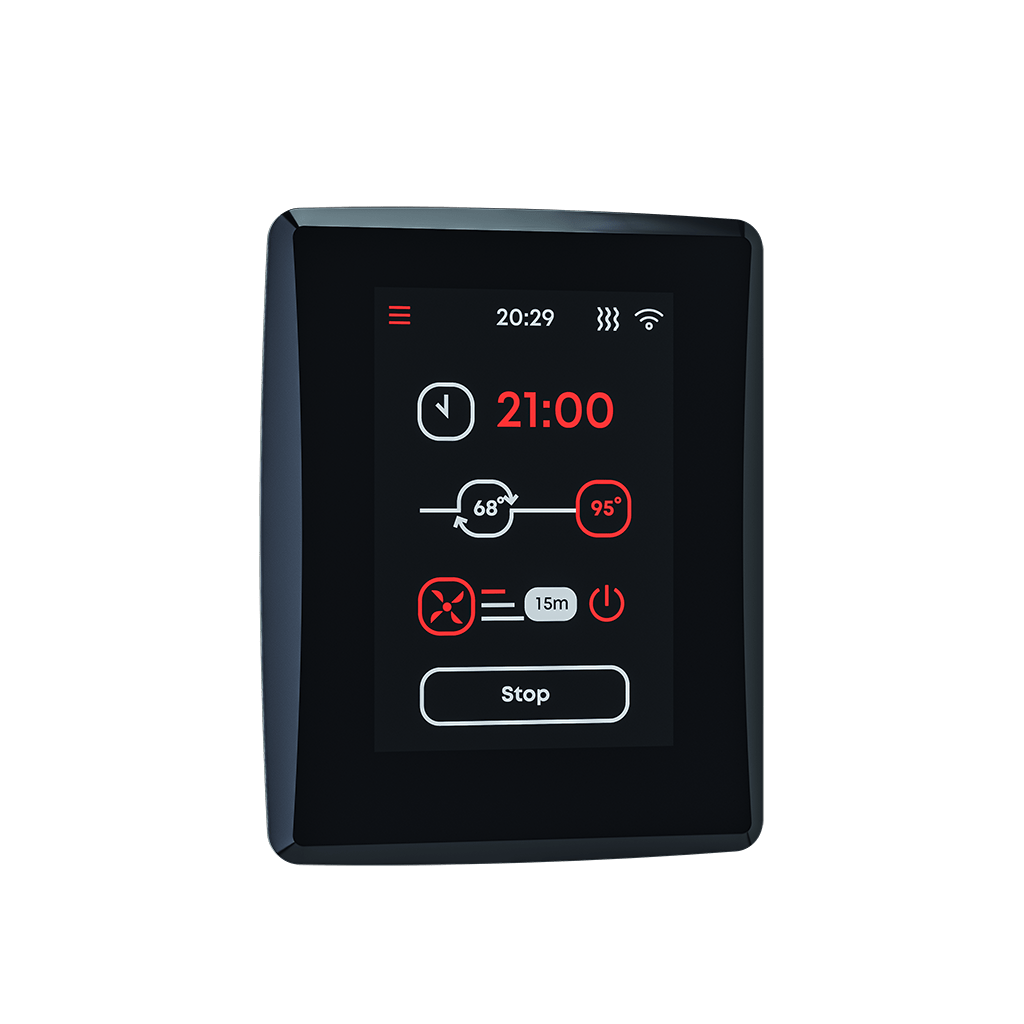
A smart control unit ties the system together. In a gym setting, the ability to schedule heating times, set multiple sauna modes, and receive safety alerts remotely is not a luxury—it is a practical necessity. The Saunum Leil controller, for example, supports three preset sauna modes, smart scheduling, mobile app control via Wi-Fi, and Modbus integration for connection to building management systems. These features allow gym staff to manage the sauna efficiently without being physically present at the unit for every adjustment.
How is a sauna air blending heater installed in a public gym?
Installing a sauna air blending heater in a public gym requires careful planning around room volume, electrical supply, safety clearances, and integration with existing building systems. The installation process involves positioning the heater, making the correct electrical connections for both the heater and the climate device, laying the sauna stones, and commissioning the control unit.
Commercial-grade units designed for public use typically require a three-phase electrical supply. For example, a 9 kW unit requires a C16 fuse on a three-phase circuit, while a 15 kW unit steps up to a C25 fuse. The heater cable specification and the climate device cable must meet the manufacturer’s requirements—typically H07RN-F or equivalent for the heater, and a separate single-phase cable for the climate device. Safety clearances must also be respected: side clearances, front clearances, and the critical distance from the top of the stone basket to the ceiling all have defined minimums that vary by power level and basket type.
For gym operators who are not managing a specialist electrical contractor directly, our professional installation service covers the full scope—transporting the unit to the site, making all electrical connections, installing the device, laying the heater stones, and providing hands-on guidance on how to operate the system. Factors such as existing cable routing, removal of an old heater, and the precise location within the sauna room all affect the final installation plan, which is why a site-specific assessment is always the right starting point.
What should gym owners look for when choosing a sauna air blending system?
Gym owners should look for a sauna air blending system that is correctly sized for the room volume, built for commercial-grade durability, and equipped with smart controls that simplify day-to-day operation. The right system should also support multiple sauna experiences so that the facility can offer variety without investing in multiple separate installations. Browse our range of commercial sauna systems to compare configurations and find the right fit for your facility.
Power sizing is the most critical technical decision. A unit that is underpowered for the room volume will struggle to maintain temperature under heavy use, while an oversized unit wastes energy. For rooms with glass doors, concrete walls, or other uninsulated surfaces, the effective volume calculation must account for the additional heat loss those surfaces create—typically by adding extra cubic meters to the baseline room volume before selecting a heater power level.
Beyond power, gym owners should consider the following factors when evaluating systems:
- Durability of materials—look for corrosion-resistant steel in the heating elements and a robust outer housing that can handle the humidity and heat cycles of daily commercial use.
- Control system sophistication—smart scheduling, remote monitoring, and safety alerts reduce the management burden on gym staff and improve the member experience.
- Multi-mode capability—a system that supports a classic Nordic sauna, a steam-rich humid sauna, and salt-ion therapy in a single unit gives the gym flexibility without added complexity.
- Manufacturer support and warranty—in a commercial setting, downtime is costly, so responsive technical support and clear warranty terms matter as much as the product specification itself.
The sauna indoor climate device should also integrate cleanly with the heater rather than requiring a separate visible unit on the wall, which can complicate the aesthetics of a premium gym environment and add installation complexity.
How Saunum helps gym operators get sauna air blending right
Saunum designs sauna air blending systems specifically to solve the temperature stratification, breathability, and operational management challenges that gym saunas face every day. Our product range includes purpose-built options for commercial environments, and our installation service takes the technical complexity off your plate entirely.
Here is how Saunum supports gym owners and contractors from specification through to operation:
- The Saunum Pro Experience heater is purpose-built for boutique public saunas and is available in 9, 12, and 15 kW configurations to match a wide range of commercial room volumes.
- The integrated Saunum Leil smart control unit supports scheduling, mobile app management, and Modbus integration with building management systems—everything a gym needs to run a sauna efficiently.
- Our professional installation service handles transport, electrical connections, stone laying, and user training, with pricing based on a precise site assessment.
- Every Saunum system supports five distinct sauna experiences in one unit—classic Nordic, humid steam, relaxing, salt-ion, and aroma—giving gym members genuine variety.
If you are specifying a new gym sauna or upgrading an existing one, Saunum is ready to help you get the system right from day one. Contact us to discuss your room dimensions, usage requirements, and installation timeline, and we will recommend the right configuration for your facility.