

Planning an indoor sauna starts with one deceptively simple question: how much space do you actually need? Get the size wrong, and you end up with a room that either takes forever to heat, feels uncomfortably cramped, or never reaches the right temperature. Whether you are converting a spare bathroom, building a dedicated sauna room in your basement, or working on a new construction project, understanding the relationship between room size and heater performance is the foundation of a great home sauna.
This guide walks through every dimension-related question you are likely to face, from minimum square footage to ceiling-height requirements, so you can plan your indoor sauna with confidence from the very first measurement.
What is the minimum room size for an indoor sauna?
The minimum practical room size for an indoor sauna is roughly 4 x 4 feet (approximately 1.2 x 1.2 meters), which provides just enough space for one person to sit comfortably. In volume terms, most residential sauna heaters are designed to heat rooms starting at around 6 cubic meters, so a small but functional single-person sauna typically falls in the 1.2 to 1.5 square meter footprint range with a standard ceiling height.
That said, a 4 x 4 space is genuinely tight. Most sauna builders and homeowners find that a 4 x 6 foot layout (roughly 1.2 x 1.8 meters) is a more comfortable starting point for a solo sauna, and a 5 x 7 foot room works well for two people. The goal is to create enough volume for the heater to work efficiently while leaving room for benches, movement, and comfortable breathing.
It is also worth noting that minimum size is not just about square footage on the floor. The total cubic volume of the room, including ceiling height, determines which heater you need. A very small footprint with an unusually high ceiling can actually require more heating power than a slightly larger floor plan with a standard ceiling.
How does ceiling height affect sauna performance?
Ceiling height directly affects both heating efficiency and comfort. A ceiling that is too high increases the total room volume, requiring more power to reach sauna temperatures. More importantly, in a conventional sauna, heat and steam rise and pool near the ceiling, creating a large, unusable hot zone above head height while the lower benches stay cooler. The ideal ceiling height for a home sauna is between 6.5 and 7.5 feet (roughly 1.95 to 2.3 meters).
Going much higher than 7.5 feet without compensating with additional heater power means you are essentially heating dead space. The steam rises, sits at the ceiling, and never reaches the people sitting on the lower benches. This is one of the most common reasons homeowners feel their sauna is underperforming, even when the heater is correctly sized for the floor area.
Why ceiling height and air mixing work together
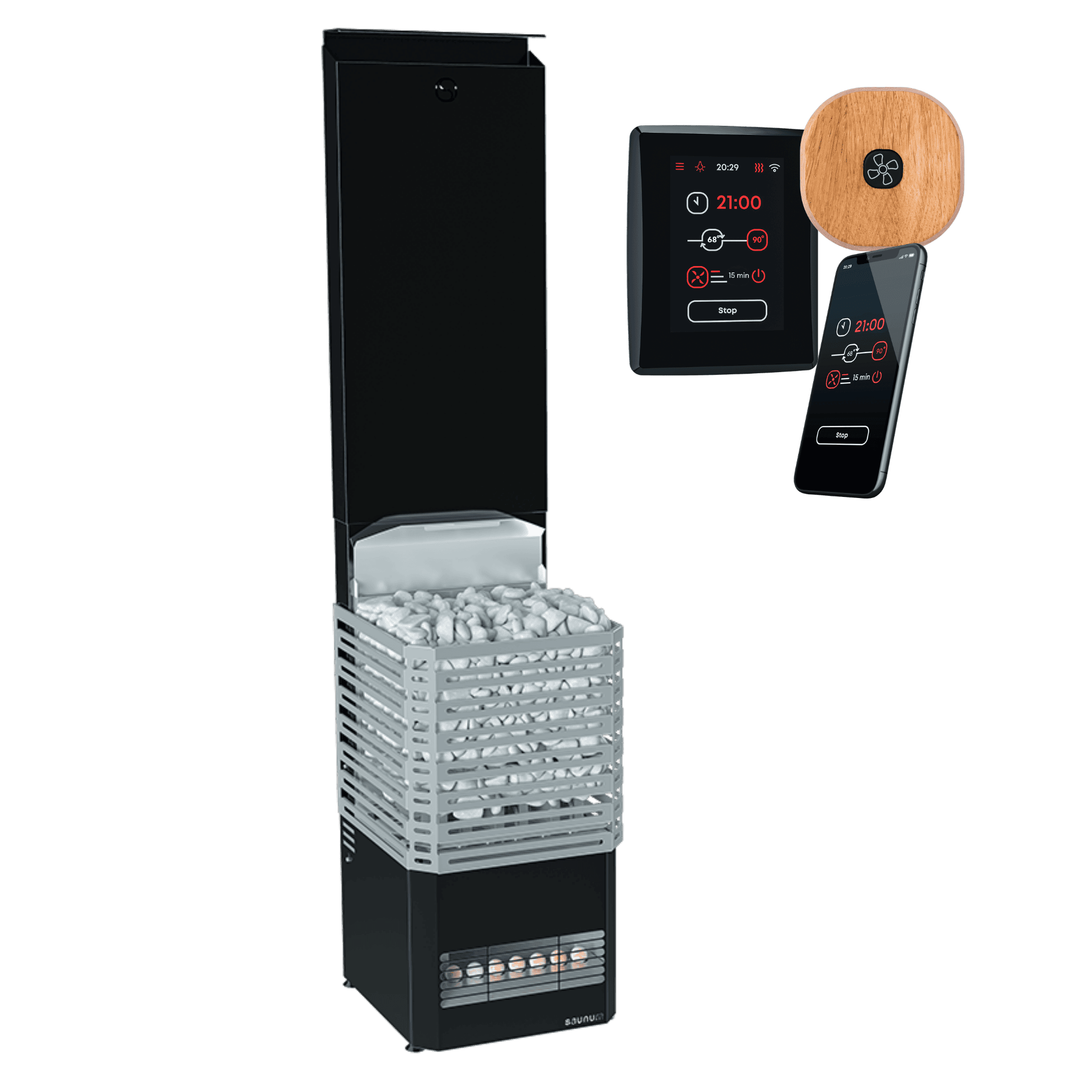
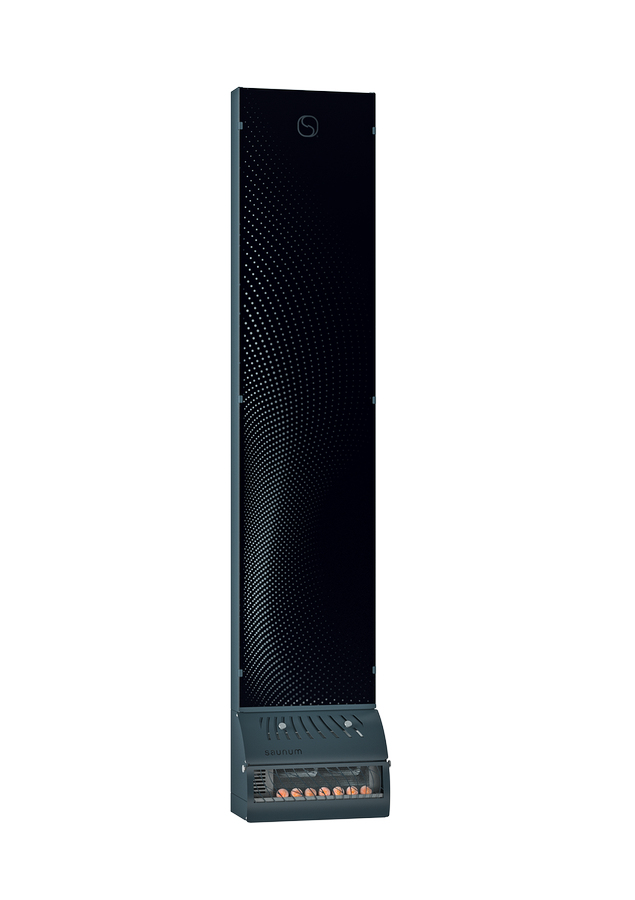
This is precisely the problem that Saunum’s patented air-blending sauna technology was designed to solve. In a standard sauna, the temperature difference between the ceiling and the floor can be dramatic, with scorching steam near the top and noticeably cooler air below. Our climate device captures that hot steam near the ceiling, mechanically mixes it with the cooler, oxygen-rich air near the floor, and redistributes it evenly throughout the room. The result is a consistent temperature from bench level to ceiling, which makes the entire room usable and the steam experience far more comfortable.
For practical planning purposes, most Saunum heater models specify a minimum ceiling height. The Spa Session, for example, requires a minimum ceiling height of 1,960 mm (just under 6.5 feet), while the Luxury model requires at least 2,150 mm. These minimums exist to ensure the climate device has enough vertical space to draw in ceiling-level air and circulate it properly.
How many cubic feet does a sauna heater need to heat?
Sauna heater sizing is based on the total cubic volume of the room, not just the floor area. As a general rule, you need roughly 1 kilowatt of heating power for every 1 cubic meter (approximately 35 cubic feet) of well-insulated sauna space. A 6 cubic meter sauna needs at least a 6 kW heater, while a 16 cubic meter room requires something in the 12 to 16 kW range.
Volume is calculated simply: length x width x height. A 5 x 7 foot room with a 7-foot ceiling equals roughly 245 cubic feet, or about 6.9 cubic meters. That falls right in the range of a 6 to 9 kW heater, depending on insulation quality.
Adjusting for uninsulated walls
Insulation quality matters significantly. If your sauna has uninsulated walls, glass panels, or a glass door, you need to add extra volume to your calculation to compensate for heat loss. A common adjustment is to add 1.0 to 1.2 cubic meters for every square meter of uninsulated surface. For example, a 10 cubic meter sauna with a glass door should be treated as approximately 11.5 cubic meters when selecting heater power. This prevents the mistake of undersizing a heater because the raw room volume looks manageable on paper.
What’s the difference between a small sauna and a full-size sauna?
The key difference between a small sauna and a full-size sauna is capacity and versatility. A small sauna typically accommodates one to two people in a compact footprint of around 16 to 24 square feet, while a full-size home sauna comfortably seats three to six people in a larger layout with multiple bench levels. Beyond seating, full-size saunas support a wider range of sauna styles and experiences.
Small saunas are popular for apartments, urban homes, and basement conversions where space is limited. They heat quickly, use less energy per session, and are easier to install. The trade-off is that bench positioning is limited, and it can be harder to achieve the classic Nordic sauna experience with multiple bench heights.
Full-size home saunas, typically starting at around 6 x 8 feet and above, allow for proper two-tier bench layouts, more comfortable lounging positions, and the flexibility to use the space for different sauna modes. They also tend to retain heat more evenly because the room volume supports better air circulation. A well-designed full-size sauna is genuinely a different experience from a compact one, not just a bigger version of the same thing.
Can a sauna be too small or too big for a heater?
Yes, both mismatches cause real problems. A heater that is too powerful for a small sauna room will overheat the space rapidly, create uncomfortably intense heat, and cycle on and off inefficiently. A heater that is too weak for a large room will struggle to reach target temperatures, take excessively long to heat up, and wear out faster because it runs at maximum capacity continuously.
Oversizing is a surprisingly common mistake. Homeowners sometimes assume that a bigger heater means a better sauna, but in a small room, excess power creates a harsh, difficult-to-control environment. The stones get too hot too quickly, steam becomes scalding rather than pleasant, and the heater’s thermostat fights against itself.
Undersizing is equally problematic in the other direction. A 6 kW heater in a 20 cubic meter room will technically produce heat, but it will never create the dense, enveloping warmth that defines a quality sauna session. Matching heater power to room volume is one of the most important decisions in the entire build process.
What are the ideal dimensions for a home sauna room?
The ideal dimensions for a home sauna room depend on how many people will use it regularly, but a 5 x 7 foot (roughly 1.5 x 2.1 meter) layout with a 7-foot (2.1 meter) ceiling is widely considered the sweet spot for a two-person home sauna. This provides enough room for a full-length bench, comfortable movement, and efficient heating without wasting energy on excess volume.
For a family sauna or a space designed for three to four people, a 6 x 8 or 6 x 9 foot room with the same ceiling height works well. This allows for an L-shaped or two-tier bench arrangement, which is both more comfortable and more traditional in Nordic sauna design.
- Single person: 4 x 6 feet minimum, 6- to 7-foot ceiling
- Two people: 5 x 7 feet, 7-foot ceiling
- Three to four people: 6 x 8 feet, 7-foot ceiling
Beyond square footage, consider door placement, bench depth (at least 18 to 20 inches for comfortable sitting, 24 inches for lying down), and the position of the heater relative to the benches. The heater should never be placed directly under a bench, and there must always be adequate safety clearance on all sides according to the manufacturer’s specifications.
How Saunum helps with electric sauna heater sizing and performance
Getting the room size and heater match right is exactly what we built our product range around. Saunum’s complete home sauna heater range offers a complete lineup of electric sauna heaters designed to cover every room size, from compact home saunas to large public spa facilities, with each model specifying precise volume ranges so there is no guesswork involved.
- The Saunum Spa Session covers sauna rooms from 6 to 16 cubic meters in 6 kW and 9 kW variants, making it ideal for most home sauna builds.
- The Saunum Pro Experience scales up to 15 kW for rooms up to 23 cubic meters, making it well suited to boutique and commercial sauna environments.
- The Saunum Luxury handles the largest spaces, with power options up to 19.8 kW for rooms up to 28 cubic meters.
- The Saunum Base adds our air-blending technology to any existing heater, solving temperature stratification without a full replacement.
Every Saunum heater includes our patented air-blending system, which actively solves the ceiling-to-floor temperature problem that affects every conventional sauna. Instead of scorching heat pooling at the ceiling while the lower benches stay cool, our climate device mixes the room air continuously for an even, breathable, and genuinely comfortable sauna experience. Combined with the 5-in-1 spa solution, you get a classic Nordic sauna, a humid steam sauna, a relaxing mild sauna, a salt ion sauna, and an aroma sauna—all from one unit.
If you are planning a home sauna build and want to make sure your room dimensions and heater selection are perfectly matched, contact us for expert sauna planning advice. Visit our sauna heater shop to explore the full product range, use our heater-sizing guidance, and find the right solution for your specific space.